No supposedly decisive wording
The emphasis is not on exaggeration or special phrases. It is on a clear, honest account of what you can and cannot sustain, told the same way across every form.
A plain-English SSDI application guide
SSDI Application Guide 2027: Apply for Social Security Disability Step by Step, in Plain Englishby Dana Whitfield
When health problems make regular work unsustainable, an application asks for more than a diagnosis. The SSDI Application Guide 2027 shows you how to connect medical care, daily limitations, work demands and important dates, then give Social Security a clear, honest account of what you can and cannot sustain.
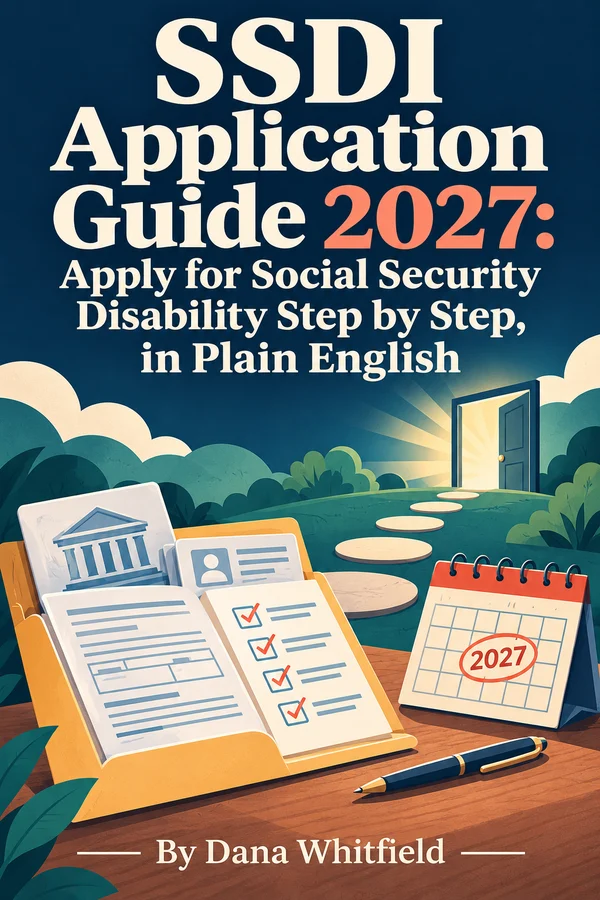
What this book explores
The approach is practical: prepare your records, describe your circumstances specifically and keep your reporting consistent from one form to the next.
Programs
The guide opens by separating the two programs: why work record and insured status matter for SSDI, while financial need matters for SSI.
Compare SSDI vs SSI eligibilityThe review
It walks through the five questions in an adult disability claim, so you can see where medical evidence and work-related limitations fit into the review.
See the five-step evaluationTimeline
When symptoms began is not always when regular work became unsustainable. The book separates the alleged onset date, last day worked and filing date.
Onset date vs last day workedEvidence
Treatment histories, medications, identifying documents and actual job duties are gathered before the forms, with discrepancies explained rather than hidden.
Build your application checklistFunction Report
Cooking, shopping, personal care, transportation and concentration become more informative when you describe limits, assistance and whether you can repeat them reliably.
Describing variable daysWork History Report
Physical demands, concentration, pace, supervision, accommodations and changes in performance, documented for each job instead of a bare job title.
Why actual job duties matterStep by step
The book follows the order an applicant actually meets things in: build the account before you complete the forms, then keep track of what happens after you submit.
Prepare records, separate the important dates and gather details about treatment and work before you open a form.
The main application and Adult Disability Report: conditions, providers, tests, treatment, medicines, side effects and work activity, including short-term, gig and self-employed work.
Monitor correspondence, keep a contact log, ask focused status questions and record problems with examinations promptly.
Questions raised by an award notice or a denial, why appeal timing matters, and situations in which a representative may help.
Why readers may choose it
The emphasis is not on exaggeration or special phrases. It is on a clear, honest account of what you can and cannot sustain, told the same way across every form.
Daily-life guidance makes room for variation. A task you manage once is described alongside its limits, the help involved and whether you can repeat it reliably.
Explain what improved and what remained difficult, rather than presenting partial relief as either a cure or no improvement at all.
Reference tools
Worksheets give you a place to organize information that might otherwise be scattered across records and letters. A glossary explains Social Security terms in plain English.
Looking for a disability symptom diary template or an SSDI application checklist? Our reader guides explain what those records are for.
Worksheet formats in the book
Who it is for
Reader questions
It covers how to prepare and present a Social Security disability application: records, dates, daily activities, work demands and what to do after you submit and after a decision.
According to its description, the book explains the SSDI and SSI distinction and the five questions Social Security asks about an adult claim. It then covers the main application and Adult Disability Report, the Function Report and the Work History Report, followed by monitoring correspondence, appeal timing and when a representative may help. It includes seven worksheet formats and a glossary. This summary describes the book's scope; it is not an independent review of its accuracy.
No. Social Security makes eligibility decisions. The guide focuses on understanding the process and preparing an accurate, organized account.
For the official rules, see Social Security's own explanation of how someone becomes eligible for disability benefits. Our SSDI vs SSI guide summarizes the key differences with links to those sources.
No. Social Security's Adult Disability Starter Kit says not to delay filing if you do not have or remember all of the information requested.
Organizing records is support, not a prerequisite. Read more about applying before gathering every record.
Book details
The book behind these guides
If you are getting ready to apply, this guide brings the records, dates, daily limits and work details together in the order the forms ask for them, with worksheets to keep them consistent.
SSDI Application Guide 2027: Apply for Social Security Disability Step by Step, in Plain English by Dana Whitfield